 Etherfi
Etherfi withdrawals depend on liquidity and the type of exit
Updated
Etherfi withdrawals release assets through staking redemption, vault settlement, or transfers from a Cash Vault. Instant staking redemption requires available liquidity and remaining redemption capacity. A queued request waits for the relevant processing conditions, while selling a transferable staking token uses market liquidity and a trading quote. Liquid vaults have their own settlement rules. The useful choice therefore depends on the asset that you need to receive, the position that you hold, and the delay or cost that you can accept.
Jump to a section
Liquidity and Available Exit Choices
Withdrawal liquidity determines whether an immediate redemption can execute, while queue processing and market prices determine the consequences of other exit choices. The instant redemption manager applies liquidity safeguards and a rate limiter. A sufficiently large token balance does not override either constraint. Its contract supports ETH and stETH, a different liquid staking token, with output-specific settings. A particular interface may expose fewer choices. Receiving stETH preserves a liquid staking position, so that output does not complete an exit whose intended result is native ETH.
Instant capacity describes present availability; other redemptions can consume capacity before a pending transaction executes.
Standard queued staking withdrawals exchange immediate access for processing through the protocol. A market sale of eETH or weETH uses buyers or trading-pool liquidity instead. The sale price can differ from the token’s underlying redemption value, and larger trades can receive less favorable execution. A fast market exit therefore trades settlement delay against the available quote. The restricted priority queue is another protocol mechanism, with eligibility and processing conditions of its own.
Token Units and Withdrawal Claims
Staking tokens, vault shares, and withdrawal claims represent different rights, so matching a displayed amount to its asset is necessary when comparing exit proceeds.
eETH and weETH Conversions
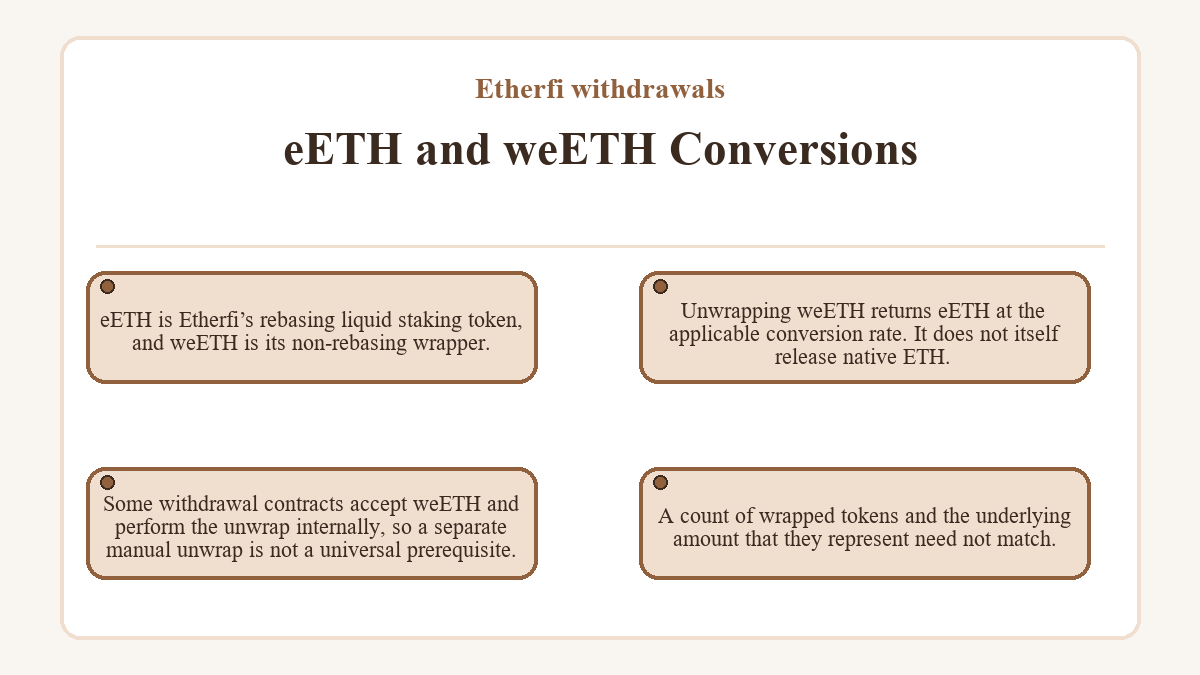
eETH is Etherfi’s rebasing liquid staking token, and weETH is its non-rebasing wrapper. Unwrapping weETH returns eETH at the applicable conversion rate. It does not itself release native ETH. Some withdrawal contracts accept weETH and perform the unwrap internally, so a separate manual unwrap is not a universal prerequisite. A count of wrapped tokens and the underlying amount that they represent need not match.
Vault Shares and Request Records
Liquid vault shares represent an interest in a strategy vault. A standard staking withdrawal instead creates a WithdrawRequestNFT, a non-fungible token that represents the withdrawal claim. Neither object is interchangeable with an already credited output balance. ETHFI unstaking is separate again: its intended output is ETHFI, whereas ETH staking redemption concerns the assets backing eETH and weETH.
How Does a Queued ETH Redemption Become Claimable?
A queued ETH redemption becomes claimable after the protocol finalizes its request and satisfies the conditions that the relevant withdrawal contract enforces.
Standard Staking Requests
The standard queue records the requested eETH amount and its corresponding shares. A standard staking withdrawal request must be finalized before its ETH can be claimed. Creating a request records the pending claim. Claiming remains a separate operation from requesting. The payout is capped at the requested amount and can be lower if the value represented by its shares declines.
Restricted Priority Requests
The priority withdrawal contract accepts requests from whitelisted addresses and supports eETH or weETH inputs. Its minimum delay starts when the request is created, and finalization must occur before claiming. The recorded payout also incorporates the request’s fee terms. A claim can revert if the request’s shares no longer cover that payout.
Validator Funding
Etherfi has used validator consolidation to replenish redemption liquidity. Consolidation has its own eligibility requirements and queue conditions. Ethereum’s full validator exit queue can affect other funding paths, but its displayed duration does not translate directly into a deadline for every staking-token withdrawal.
Liquid Vault Queues and Settlement
Liquid withdrawals release assets from managed strategies, so available funds, strategy operations, and the vault’s withdrawal mechanism jointly affect the time to settlement.
Unallocated Liquidity
Liquid keeps part of its funds outside active strategies to support withdrawals. That allocation may earn little or no yield, which creates a trade-off between deployed capital and readily available funds. A vault’s total balance therefore measures something different from its withdrawal liquidity. Heavy demand or strategy settlement can still delay a withdrawal even when the vault holds substantial assets.
Maturity and Expiry Conditions
Veda-based vaults using BoringOnChainQueue attach a maturity delay and an expiry deadline to withdrawal requests. A solver fulfills a request within its permitted window and delivers the required output. The expiry deadline limits fulfillment; it does not promise payment before that date. Older Veda vaults used the shared Atomic Queue, a legacy mechanism that Veda has replaced with BoringQueue. Midas-based vaults have a different architecture.
Output Assets and Delivery
The withdrawal selector lists available output assets for the connected chain. In the Cash Liquid withdrawal flow, completed payouts reach the wallet automatically without a manual claim. A staking-token payout can leave another redemption necessary before native ETH becomes available. The processing estimate shown for a withdrawal describes expected timing; liquidity, queue demand, and strategy operations can extend it.
Fees and Net Exit Proceeds
Exit costs differ between redemption, a market sale, and a vault withdrawal, so the received asset amount matters alongside the expected wait. Instant redemption applies the configured exit fee for its output asset. A trading quote reflects market execution and any trading charges. Comparing raw weETH units with an ETH quote also requires the relevant conversion rate. A lower explicit fee can accompany a less favorable quote or a longer period before the proceeds become usable.
Vault management charges can already affect the value of the position, while withdrawal terms can include compensation for settlement costs. The vault’s fact sheet and withdrawal preview describe those charges. Network gas is a separate expense associated with the transactions that the selected exit requires.
Cash Transfers and Collateral Restrictions
A Cash Vault withdrawal transfers a supported asset to an external wallet on a compatible network, and that transfer can leave the underlying earning exposure intact. Moving weETH changes its location; it does not redeem the staking position for ETH. Cash’s weETH staking flow requires redemption through a supported Ethereum interface using an external address under the user’s control. Destination support must match both the token and the selected network. An identical-looking wallet address on another network does not establish that an exchange or wallet accepts the transfer.
Collateral securing a loan can impose an additional withdrawal restriction. The Borrow interface limits collateral removal to what keeps the position inside its applicable borrowing constraints, so it may cap or reject the requested amount. The published lending terms also require repayment of all borrowings before collateral withdrawal. Debt, interest, collateral prices, and risk settings affect that headroom. Supplied lending assets can also face a liquidity constraint when much of the reserve is borrowed. These restrictions concern the pledged or supplied position, rather than every freely held token in the account.
Repaying debt improves collateral headroom; withdrawing supplied assets still requires enough liquidity in the corresponding lending reserve.
An Exit Check for Spendable Proceeds
For a vault withdrawal through BoringOnChainQueue, suppose the proceeds must arrive as a usable balance in the destination wallet. A pending request does not satisfy that need.
- Identify the output asset and the least proceeds that would make the exit useful.
- Compare that requirement with the request’s output amount, maturity delay, expiry deadline, and available liquidity.
- Authorize the queue to use the required shares and submit the withdrawal only on acceptable terms.
- Count fulfillment as completion when the selected output reaches the wallet; request acceptance alone leaves the proceeds pending.
- If the request expires unfulfilled, reassess its terms and use the queue’s permitted cancellation or replacement option.
Cancellation returns vault shares. Replacing an unfulfilled request restarts its maturity timing, so an earlier estimate no longer describes the replacement’s completion.
Still wondering about Etherfi withdrawals?
Why Did My Token Approval Succeed Without Creating a Withdrawal Request?
A token approval authorizes spending; it does not by itself request a withdrawal. The withdrawal operation still has to execute through the selected contract. Some contract methods accept a permit signature within that operation, so the number of separate transactions depends on the method and the interface.
Can I Cancel a Priority Withdrawal and Recover weETH?
Cancellation through the priority withdrawal contract returns eETH corresponding to the request’s shares, even when the original input was weETH. The request owner must satisfy the contract’s maturity and cancellation conditions, including its pause checks. Recovering weETH would require wrapping the returned eETH; cancellation itself does not perform that conversion.
Does Transferring a Withdrawal NFT Change Who Receives the ETH?
The standard withdrawal NFT identifies the owner who receives the claim proceeds. Transferring a valid NFT transfers that right, subject to the contract’s transfer restrictions. The payout follows the NFT’s owner at claim time, rather than necessarily returning to the address that originally requested the withdrawal.
Where Do Liquid Vault Rewards Appear When I Withdraw?
Liquid vault yield accrues within the vault position rather than arriving as a separate reward token. The value represented by the vault shares incorporates the strategies’ returns, while fees and losses can affect that value. The redeemed position and applicable withdrawal terms determine the proceeds; a displayed yield estimate is not an additional payout.
Do Failed Etherfi Withdrawal Transactions Still Cost Gas?
An Ethereum withdrawal transaction that executes and reverts can still consume gas because the network charges for computation already performed, while rejecting a wallet prompt or never submitting the transaction does not create that on-chain execution charge.
Why Does My Legacy LQIDETHFIV1 Redemption Return LiquidETH?
The legacy LQIDETHFIV1 redemption returns LiquidETH because it redeems that older vault position into the LiquidETH vault token. Receiving LiquidETH therefore preserves a vault position. Withdrawing through the LiquidETH vault provides its supported output assets, and receiving a staking token can leave native ETH redemption as a further operation.
Is Converting sETHFI Back to ETHFI an Instant Withdrawal?
Converting sETHFI to ETHFI uses the ETHFI unstaking process and has an expected processing time of up to 14 days. A pending request settles automatically when that process completes. Its status and estimated completion time appear with the staked ETHFI position. The Cash account should remain active until the withdrawal completes.
How Can I Withdraw a Cash Vault ETHFI Position While Using Android?
Cash web supports direct withdrawal of an ETHFI position held in a Cash Vault. The Android app does not currently provide that direct withdrawal option; the iOS app also supports it. A position staked through a personal wallet uses the personal-wallet withdrawal process, so its ownership context determines the appropriate interface.