 Etherfi
Etherfi weETH Collateral for DeFi Loans
Updated
Etherfi weETH can back DeFi loans in markets that accept it as collateral, while retaining exposure to the underlying staked ETH. Borrowing creates interest-bearing debt and subjects pledged weETH to the market’s liquidation rules. Acceptance, available liquidity, and collateral limits determine whether a particular loan is possible.
Pledging weETH adds lending records and debt accounting to the existing staking exposure. The lending protocol values collateral, charges borrowing interest, and controls how much of the pledged balance can leave the position. These rules apply alongside the token’s own staking mechanics.
Key takeaway: weETH retains staking exposure when pledged as collateral, while the lending market governs borrowing capacity and liquidation.
Eligible Collateral and Confirmed Loans
A direct loan with a separate collateral deposit requires accepted weETH on the chosen network. For a wallet already holding weETH, the wallet balance and the market’s position records describe different parts of the loan. A deposit into a reserve with collateral use disabled does not establish borrowing capacity.
- Match the held weETH contract and network to the market’s accepted collateral before granting transfer permission.
- Where an allowance is necessary, authorize the intended spender. Approval alone does not credit collateral.
- Wait for the supply operation to confirm, then inspect the credited balance and any separate collateral-use setting.
- Keep the proposed loan within available liquidity and permitted debt limits, with the intended receiving account specified.
- Reconcile the confirmed borrow with both the debt record and the borrowed asset delivered to that account.
If a deposit remains pending, wait for its status before proceeding. A confirmed deposit with collateral use disabled requires enabling it where permitted, or stopping if the market cannot accept it.
weETH Units and Lending Receipts
weETH is Etherfi’s non-rebasing wrapper of eETH, the protocol’s rebasing liquid staking token. Staking rewards change the underlying value represented by each weETH token. They do not increase the wrapped token count merely through rebasing. Wrapping converts eETH into weETH using the staking pool’s share accounting. Unwrapping converts those shares back into eETH at the applicable conversion rate. The two token amounts therefore need not match.
Collateralizing weETH retains that underlying exposure while the lending position remains backed by the token. The collateral still carries ETH price exposure and the staking protocol’s accounting dependencies.
Aave V3 represents supplied assets with reserve-specific aTokens. Those receipts track the lending claim, while weETH’s conversion value reflects the underlying staking position. A supply receipt and the original tokens that it represents describe the same deposited principal. Counting both as separate collateral would overstate the position. Any reserve interest belongs to the lending receipt’s accounting and needs separate treatment from staking rewards.
Borrowing Limits and Collateral Valuation
Borrowing capacity follows the lending market’s valuation of pledged weETH and the parameters that apply to the chosen position. Loan-to-value (LTV) compares debt value with collateral value using a consistent valuation basis. Aave V3 distinguishes the maximum LTV for new borrowing from the liquidation threshold used to assess position health. Governance can adjust these reserve parameters. A supply cap can block a deposit, while a borrow cap or insufficient loan-asset liquidity can prevent a new draw. The balance displayed in a wallet does not establish the amount available to borrow.
The market’s oracle supplies the price that its lending contract uses to value collateral. Morpho Blue markets identify a particular collateral token, loan token, oracle, interest rate model, and liquidation LTV at creation. Those market parameters remain fixed, although prices and borrowing rates change. Different weETH markets can therefore use different valuation arrangements. An oracle valuation need not equal executable sale proceeds: trading liquidity, conversion fees, and slippage affect the amount received. Selling collateral to fund repayment can raise less than the collateral value shown in the lending account.
Staking Rewards Against Borrowing Costs
Staking income and borrowing interest accrue against different balances, so a quoted yield spread does not establish a profitable position. The staking return applies to the underlying exposure represented by the collateral. Borrowing interest applies to the debt actually outstanding, including accrued interest under the market’s accounting. Subtracting the two percentage rates ignores their different balance sizes. A return quoted in ETH also needs conversion before comparison with costs denominated in another asset. Network transaction charges and any trading costs further affect the outcome. Variable rates can change the relationship while the loan remains open.
Morpho Blue does not pay lending interest on assets posted through its collateral-supply function. weETH’s underlying staking exposure continues independently of that rule. Aave V3 supply positions have a separate reserve interest rate that depends on utilization and reserve configuration. These lending returns, where applicable, belong alongside staking rewards as distinct accounting components. Neither collateral eligibility nor a staking yield quote specifies the future cost of borrowing. The loan’s debt asset, interest model, and outstanding balance determine that cost.
Liquidation Exposure and Debt Currency
Liquidation depends on the value of weETH relative to the outstanding debt and the market’s applicable threshold. In Aave V3, a health factor below 1 makes a borrowing position eligible for liquidation. Its calculation divides total collateral value, adjusted by the weighted liquidation threshold, by total debt value. Price changes and accrued borrowing interest can reduce that figure even when the deposited token count stays unchanged. A health factor above 1 describes present collateral coverage; a later price movement can reduce it.
Stablecoin debt responds differently from debt denominated in ETH or its wrapped form. A fall in ETH’s value can weaken coverage for stablecoin debt. ETH-correlated borrowing reduces one source of currency mismatch, while leaving borrowing interest and weETH-specific valuation risk. A stablecoin’s own price movement can also affect the comparison when the market’s oracle reflects it. Repayment reduces outstanding debt, and adding eligible collateral increases the value supporting it, subject to the relevant market rules.
Liquidators in these lending models repay eligible debt and receive collateral under the market’s incentive rules. The borrower loses the collateral taken, so continuing staking exposure applies only to the remaining position.
Market Restrictions and Collateral Release
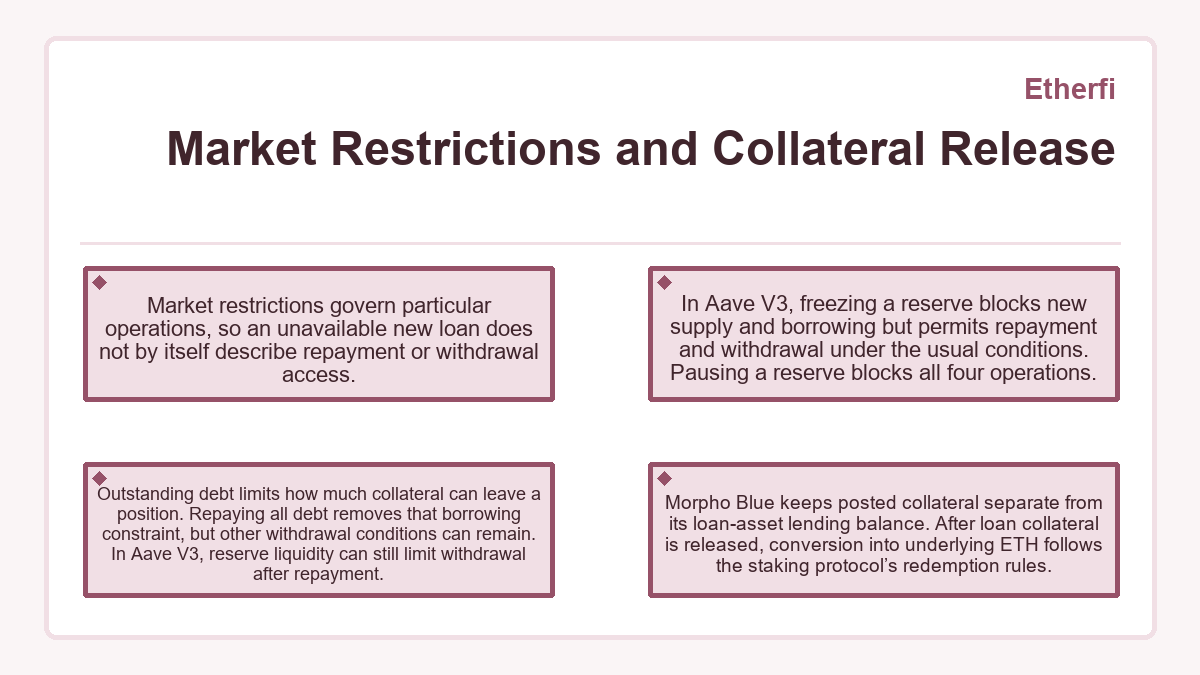
Market restrictions govern particular operations, so an unavailable new loan does not by itself describe repayment or withdrawal access. In Aave V3, freezing a reserve blocks new supply and borrowing but permits repayment and withdrawal under the usual conditions. Pausing a reserve blocks all four operations. Outstanding debt limits how much collateral can leave a position. Repaying all debt removes that borrowing constraint, but other withdrawal conditions can remain. In Aave V3, reserve liquidity can still limit withdrawal after repayment. Morpho Blue keeps posted collateral separate from its loan-asset lending balance. After loan collateral is released, conversion into underlying ETH follows the staking protocol’s redemption rules.
Etherfi: what people ask
-
Is ETHFI Interchangeable With weETH for Loan Collateral?
- ETHFI and weETH are separate tokens with different economic roles. ETHFI enables protocol governance, while weETH represents wrapped staked ETH. A market that accepts weETH does not thereby accept ETHFI, and holding ETHFI does not create a weETH collateral balance. Each asset needs its own explicit admission and parameters in the lending market.
-
Can I Supply eETH to a Lending Market That Requests weETH?
- A market that accepts only weETH requires weETH collateral, even if the wallet holds eETH. Wrapping converts eETH into weETH at the protocol’s share conversion rate. An interface that accepts eETH as the starting input must implement that conversion before crediting weETH collateral. Its deposit preview needs to identify the token that the lending contract will record.
-
Which Token Repays a Loan Secured by weETH?
- A standard repayment settles debt in the borrowed asset, even when weETH supplies the collateral. Aave V3’s repayment function specifies the borrowed asset. Some interfaces support repayment using collateral through conversion integrations, subject to their supported assets and available routes. Holding weETH alone does not establish repayment support for every loan asset.
-
Does Approving weETH Authorize a Lending Contract to Spend Other Tokens?
- A standard ERC-20 approval gives the specified spender an allowance for that token and amount. It does not grant a blanket allowance across the wallet’s other assets. A large or unlimited weETH allowance can cover more weETH than a single deposit needs. Changing or revoking it affects that spender’s ability to transfer weETH under the allowance.
-
How Does Aave V3 E-mode Affect Borrowing Against weETH?
- Aave V3 E-mode applies category-specific collateral parameters and borrowing permissions when the position qualifies for that category. The category identifies which assets can secure debt and which assets users may borrow. Inclusion as collateral does not automatically make every listed asset borrowable. The permitted loan asset and applicable liquidation parameters must match the enabled category.
-
Why Can a Repayment Leave a Small Debt Balance Against weETH?
- Interest accrual between a displayed quote and execution can leave debt after a payment targeting the earlier amount. Integer rounding can also matter. Morpho Blue tracks borrowing with debt shares; repaying the entire share balance addresses full closure more precisely than reusing an old token amount. The transaction still needs enough of the loan token to settle those shares.
-
Are My weETH Collateral and Loan Balances Publicly Visible?
- Direct onchain loan positions expose collateral and debt data for the lending account. Aave V3 provides public account-data queries, and Morpho Blue records positions by account and market. Transaction records can also reveal funding, repayments, and collateral movements. The address itself does not supply a legal name, although linked transactions can make activity easier to associate with an identity.